
2020 Census
Every Person Counts!
Every ten years, the United States undergoes a census to count all residents of the country. This census is required by the United States Constitution and is a crucial part of how our country works politically and economically. Every person should take part!
An accurate census is critical to ensure effective representation of Minnesotans in the government. A complete census also ensures Minnesotans get their fair share of federal funds. In addition, it provides accurate population data to public and business planners for long-term planning. The 2020 census is the first that will include an online response option. Census Day is April 1, 2020, though census staff will continue to obtain and verify survey responses through September 2020.
In preparation for the census, it is also important for local governments to do their part and for the state government to allocate adequate funding to ensure a complete and accurate count. The results of the U.S. census will affect the future of Minnesota and our local communities.
The Census is used for:
Have Questions? Get Answers!
English: Text COUNT to 662020
Spanish: Text CENSO to 662020
Somali: Text TIRI to 662020
Hmong: Text SUAVPEB to 662020

Political Representation
Census data determines how many representatives each state gets in the U.S. House of Representatives. Minnesota is in danger of losing a seat because our population has grown at a slower pace than other states. An accurate count ensures Minnesota has the best chance to keep all eight of its Representatives. Census data also determines how many votes Minnesota gets in the Electoral College, which selects the President.
The census also helps us draw congressional and state legislative district boundaries. A complete and accurate census is crucial to support redistricting of the state in a way that assures representative democracy.
Want to learn more about political power and representation?
Check out our page on redistricting!

Federal Funds
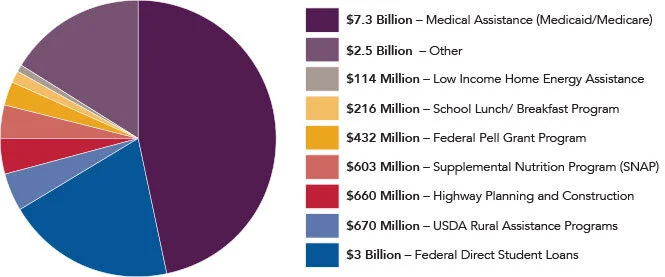
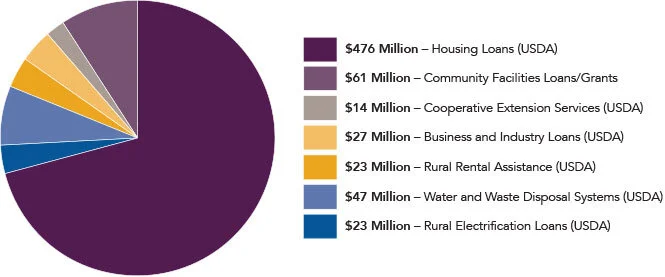
At least 55 federal programs use census data to distribute federal funds. One study published in May 2019 estimates that Minnesota received over $15 billion in federal funds in 2016 alone through these programs. These funds included over $6 billion for Medical Assistance (Medicaid), $3 billion for Federal Direct Student Loans, $650 million for highway planning and construction, and $475 million for low-to-moderate income housing loans. For each person not counted in the 2020 census, Minnesota will lose about $2,800 in federal funding per year. See charts below.

Planning for government and business
State and local governments, as well as businesses of all sizes, use census information to plan future activities. A complete and accurate count allows the state of Minnesota and local governments to make informed planning and policy decisions for housing, transit, health services, business development, and more. This also allows businesses to make the best decisions on future business planning and strategies to serve the needs of residents.
2016 Federal Funding for Minnesota – Statewide
2016 Federal Funding for Minnesota – Rural Areas Only
Census Challenges
There is a long history of challenges in obtaining a complete count during the census. An undercount negatively affects Minnesota’s political representation, federal funding, and planning abilities. Some potential causes of undercounting include:
-
Language Barriers. Many people in Minnesota may experience language barriers when trying to learn about or respond to the census if their primary language is not one of the 59 supported by the census.
-
Highly Mobile Residents. Responding accurately to the census can be difficult for those without a stable or permanent residence due to relocation, temporary work assignments, college or university attendance, or homelessness.
-
Distrust of Government. Some people will be reluctant to speak to anyone representing the government or to share information with the government due to distrust. This can include fears about retribution against immigrants. As of July 2019, the census survey will not have a question regarding citizenship status. However, the public discussion on the question and ongoing pressures on immigration will likely make many non-citizens and immigrants reluctant to participate. This includes non-citizens who legally reside in Minnesota, like refugees and green card holders, as well as immigrants who are U.S. citizens through naturalization.
-
Technology Barriers. This year’s census will be the first conducted primarily online. This will present challenges to individuals without internet access or who are not technologically adept.
-
COVID-19. The emergence of the novel coronavirus and outbreak of the COVID-19 illness has required a significant reduction in public contact, including a reduction in business and government services. While online resources remain available and people can continue to respond to the Census online, by phone and through a paper questionnaire, this issue impacts the ability of Census Workers to get into communities to count those who have not self-responded. The Census Bureau has delayed most Census Worker field activities until June 1. This includes implementation of Mobile Questionnaire Assistance, in-person follow-up at households which have not responded to the Census (delayed from May 13 to August 11), and the deadline for self-response by individuals (extended from July 31 to October 31). With this added challenge, it’s even more important that every person that can self-respond does so to ensure a complete count of Minnesota. •••
Who Are Our Historically Undercounted Communities?
Historically undercounted communities are groups of people with a common trait that the census has not accurately counted in the past. In other states, these communities are sometimes called “hard to count” communities. In Minnesota, however, we refer to these communities as “historically undercounted communities.” These communities include:
-
Young children (ages 0-4)
-
Renters
-
Highly mobile persons
-
Young adults (ages 18-24, especially those in college)
-
Racial and ethnic minorities
-
Native/Indigenous people
-
Non-English speakers
-
Low income persons
-
Persons experiencing homelessness
-
Persons who distrust the government
-
Persons with mental or physical disabilities
-
Persons who do not live in traditional housing
-
Persons born outside the United States, including green card holders and undocumented immigrants
-
Snowbirds
-
Individuals without internet access
This interactive map shows the geographic locations of undercounts in Minnesota during the 2000 and 2010 census.
Take Action / Printables
2020 Census Action Kit
Want to take action? Check out our Census 2020 Action Kit with tangible steps that anyone can use to start immediately.
2020 Census Flyer
Download and print this two-sided, 8.5 x 11 flyer to use as a handout for your next event. It offers the same content as this page.
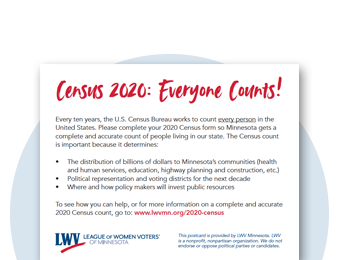
2020 Census Postcard •••
Download and print this two-sided, 8.5 x 11 sheet (four postcards per sheet) to use as handouts for your next event. •••
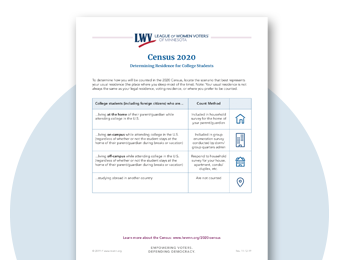
2020 Census – Determining Residence for College Students •••
Download and print this one-page, 8.5 x 11 flyer to use as a handout and/or resource when interfacing with college students. •••
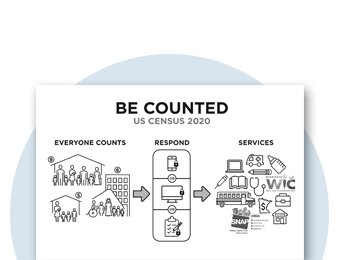
2020 Census – Be Counted
Download and use this graphic on social media, on your local League websites, or in presentations to help your communities learn how and why the Census is important.
2020 Census Discussion
Segment 2 of this video features Susan Brower, MN State Demographer, and Paul Huffman, discussing the Census. Segment starts around 14:15.
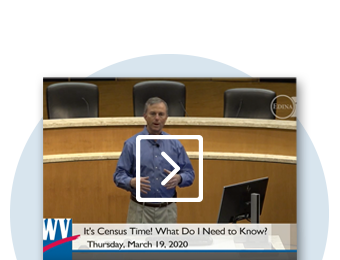
2020 Census Presentation •••
Watch this 45 minute presentation by Paul Huffman to learn all you need to know. Sponsored by LWV Edina and the Edina Complete Count Committee (CCC). •••
Additional Resources
For Everyone
For U.S. Residents
For Minnesotans
-
We Count MN via Minnesota State Demographic Center
-
LWVMN FAQs •••
-
Counting for Dollars 2020 – The role of the decennial census in the geographic distribution of federal funds to Minnesota
-
Census 2020: Helping ensure rural Minnesota participation is robust and complete – Information on rural importance and impact of the Census provided by the Blandin Foundation.
-
A presentation by a representative from the State Demographic Center, recorded by LWV of White Bear Lake Area
For Businesses
-
ReadyNation via Council for a Strong America