
Capitol Letter for March 20

One Week Left to Easter Deadline
With MN Legislative Committees facing the first and second deadline to act favorably on all bills before the Easter/Passover break begins on March 27, LWVMN’s policy priorities face an uphill battle to pass in the divided legislature.
However, the last few weeks brought to light many important issues and some bipartisan support as you will see in the Observer Reports and news coverage below. Many proposals to prevent gun violence were heard in the DFL-controlled MN Senate, and we will continue to send Action Alerts on issues supported by our members. Please take some time to review the bills covered by our Observer and Lobby Corps and consider joining us to help shape our advocacy at the Capitol!
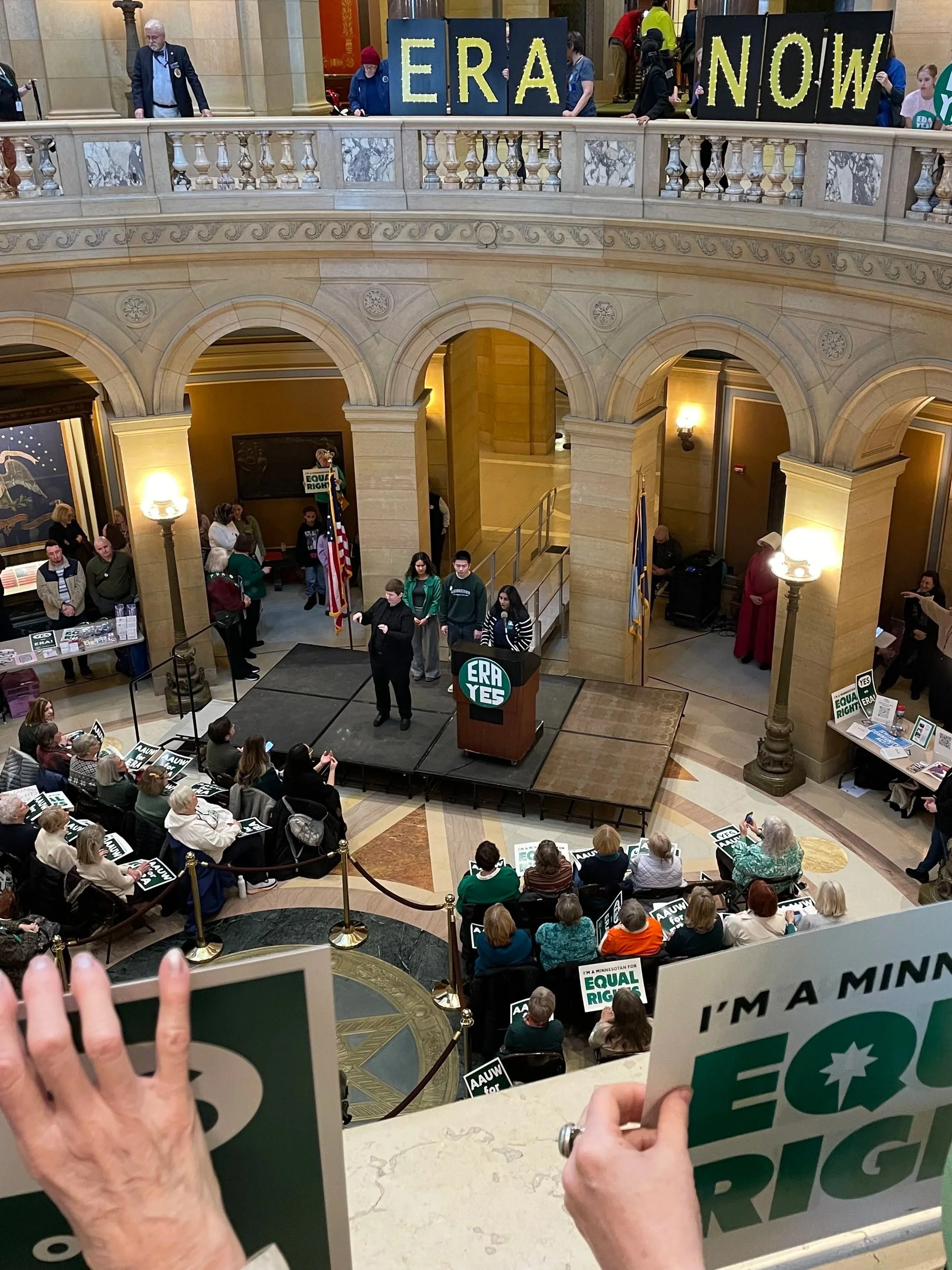
LWVMN was delighted to join the 2026 ERA Rally on March 12 with the Minnesotans for Equal Rights coalition, where three powerful high school students spoke on behalf of us and future generations of leaders. We know that our advocacy together lays the groundwork for sustained engagement and future legislative action.
Finally, we joined a letter from the MN Council of Nonprofits calling on Gov. Walz, Lt. Gov Flanagan, and legislators to protect and expand public services, and we’ll continue using our policy positions to support or oppose legislation. Please see our positions in response to the bill hearings in the Observer Reports below.
Observer Reports on Elections, Immigration, and Data Centers
-
LWV Position related to Provisional Ballots for Election Day Registration - Voter Representation/Electoral Systems: League of Women Voters supports electoral methods that:
Encourage voter participation and voter engagement; and
Promote access to voting.
LWVMN Observer and Lobby Corps Member Kathy Lovell
HF3845-Certain voters who register on election day required to cast provisional ballots and conforming changes made.
Author Rep. Duane Quam (R-Dist 24A) presented this bill which states that if an individual is unable to provide a MN Driver's License number, a MN State Identification number, OR a Social Security Number, the individual may register and cast a provisional ballot. This individual would then have seven days following the election to present one of the above stated items at the County Auditor/Municipal Clerk office during their business hours and then their vote would be counted. The bill also outlined the administrative steps to be taken at the time the provisional ballot is cast and how these ballots would be handled by the election officials. Rep. Quam stated there are a large number of registrations at the time of voting and no time is given to verify information.
Testimony in opposition: Nicole Freeman, Office of the MN Secretary of State. Ms. Freeman stated concerns about this bill which include:
the administrative consequences of these changes so close to the 2026 election
the requirement of administrative changes
the training of county election officials which begins in mid-April
the need to set up a tracking system of the provisional ballots
the increase in cost due to the complexity of the changes.
Committee Discussion: Rep. Quam stated that MN averages over 10,000 bad registrations a cycle and multiple races are decided by only a few hundred votes. The integrity of these elections needs to be insured. Rep. Ben Davis (R-Dist 6A) stated that most fraud happens with same day voting. This bill strengthens the integrity and security of elections. He stated 94% of states use provisional ballots. Rep. Emma Greenman (DFL-Dist 63B) does not think provisional ballots are needed; many close elections have held up under scrutiny. Provisional balloting developed due to states turning voters away. She also indicated a fiscal note is needed on how much these changes would cost and questioned if they could be implemented a month before the upcoming primary elections. Rep. Drew Roach (R-Dist 58B) stated his support for the bill saying it just verifies that people are qualified to vote.
A roll call vote was requested by the Co-Chair of this Committee, Rep. Mike Freiberg (DFL-Dist 43B). Voting Result: 6-6 Bill did not prevail.
More Coverage from MN House News
Written by Election and Redistricting Policy Coordinator Paul Huffman - LWV Minnesota opposes the implementation of provisional ballots for Election Day registration due to:
The additional burden placed on voters and election officials without a commensurate increase in election security;
The extremely low demonstrated frequency of ineligible voters registering and voting using Election Day Representation (EDR);
The potential for errors in the review process due to the large volume of provisional ballots which would need to be processed in a short period of time; this poses a risk of either disenfranchising eligible voters or failing to identify ineligible voters who may improperly vote in the future;
The potential for disenfranchisement of eligible voters due to not taking action to “cure” ballots;
Significant staffing and cost, in a time of limited budgets, to expedite the review and validation of election day registrations to support election certification.
Basis for these conclusions:
Neither federal nor state law currently requires Minnesota to use provisional ballots.
Over 162,000 ballots cast through EDR in Minnesota during the 2024 election. This was approximately 4.4% of all ballots cast in the election. Proposed legislation (HF 3845) only provides 3 days for local election officials to review these provisional ballots and accept or reject them
A 2018 audit of voter registration by the Office of the Legislative Auditor found that at most 37 potentially ineligible voters registered and voted using EDR, for reasons other than past felony convictions. (The actual number is likely lower.) This constituted only 0.01% of the EDRs in 2016 (1 in 10,000) and 0.001% of all ballots cast (1 in 100,000 votes).
An MIT Election Lab analysis of the 2024 Election Administration and Voting Survey (EAVS) Report from the federal Election Assistance Commission (EAC) found that nationally about 25% of provisional ballots were not counted. Using this as a basis, requiring 162,000 provisional ballots to be processed creates the potential to disenfranchise as many as 40,000 people. (The likely number to be affected is lower.)
-
LWV Position - “The methods of financing political campaigns should:
Enhance political equality for all citizens.
Ensure maximum participation by citizens in the political process; protect representative democracy from being distorted by big spending in election campaigns.
Provide voters sufficient information about candidates and campaign issues to make informed choices; ensure transparency and the public’s right to know who is using money to influence elections.”
LWVMN Election and Redistricting Policy Coordinator Paul Huffman
SF 4147 (Boldon) - Reversing Citizens United, Certain Powers of Entities Modification. This bill proposes changing state law regarding the powers of corporations to specifically state that corporations doing business in Minnesota, whether registered in Minnesota or another state, do not have the power to “directly or indirectly, contribute, expend, transfer, or disburse money or anything of value to support or oppose” candidates for elected office, political action committees, or ballot measures. This bill is patterned on a paper posted in the Center for American Promise (https://www.americanprogress.org/article/the-corporate-power-reset-that-makes-citizens-united-irrelevant/) and a constitutional amendment currently proposed in Montana.
The proposed bill would revoke and re-grant the existing corporate powers in Minnesota statute 302A.161 and add statements to section 300 of corporate statutes to define terms related to political spending powers and legal entities, and to prohibit corporations from spending funds on election activities. Corporations affected include both for-profit investor-owned and privately held companies, as well as nonprofits such as charities, labor unions, 501(c)(4) nonprofits, and chambers of commerce. The authors claim that the proposed statute would prohibit corporations from giving corporate funds directly to political action committees and Super PACs, however would not address individual contributions.
Sen Boldon presented the bill as a means of addressing, at least in part, the issues created by Citizens United regarding the ability of corporations, including 501(c)(4) nonprofits, to contribute to candidate campaigns. She noted that outside spending on elections rose from $144M in 2008 (before the Citizens United decision) to more than $4.5B in 2024, with over half of spending coming from dark money.
Testifiers included:
Minnesota Chamber of Commerce opposed the bill as they saw it as unconstitutional because it required “individuals” to give up their rights to obtain a benefit, namely, to give up their first amendment rights to form a corporation and do business. He pointed out that the bill enacted by the legislature in 2024 prohibiting campaign contributions by companies with some degree of foreign ownership was overturned and the state was required to repay legal fees of over $700,000.
Brennan Center and Clean Elections Minnesota both testified in support of the bill claiming it would help reduce corporate spending on elections.
Tom Moore from Center for American Progress, the author of the analysis proposing this strategy, testified in support of the bill.
Sen. Bahr noted that some testifiers noted that there would still be holes in campaign finance allowing wealthy individuals to contribute large amounts of money to campaigns and electioneering. He questioned whether the bill would impact individual donors or independent expenditures. Sen Bolden discussed all the things the bill would cover (e.g., non-natural born persons, corporations). Tom Moore added that the bill would not impact spending by PACs, or contributions by individual donors or independent expenditures. He noted that there is a separate bill in the U.S. 1st circuit regarding a Maine law to regulate Super PACs.
Sen. Bahr stated that he would like to see all money in elections go through candidates’ campaigns, and to eliminate PACs and Super PACs. His concern is that the money currently going to PACs will end up going to Super PACs. He agrees with the need for reform, and appreciates this effort, though he is concerned this may not address it.
Tom Moore responded that the true “dark money” is coming from 501(c)(4)s to the Super PACs. If an individual gives money to a PAC or Super PAC, that individual’s donation would be disclosed whereas the donation of an individual via a corporation would be hidden. He believes this bill will prohibit corporations from giving money to Super PACs.
Sen Lucero took issue with whether the bill increases transparency in election funding or prohibits spending on elections. Sen Boldon stated that the transparency comes from eliminating the contributions by corporations which hide the source of funds coming to a Super PAC. Sen Lucero made the point that both businesses and individuals pay taxes. His conclusion is that Democrats want to tax corporations and regulate their business and then deny businesses their ability to support their interests. He stated that the bill was devoid of reality and that businesses need to be able to weigh in on elections to assure a healthy business environment and preserve jobs.
Sen Mathews challenged the bill based on the view that businesses are not people. He stated that the statement by Justice Scalia in his concurrence was misrepresented by advocates of the bill. He noted that Scalia noted that members of companies and other organizations have the right of association and therefore speech. He noted, as the Chamber of Commerce did, that the bill was likely unconstitutional and would be struck down on court, costing the residents of Minnesota the court costs.
Sen Mathews also took issue with a section of the bill that stated that a court could not revive or reinstate and part of the bill which was superseded. (A business could not ask for reinstatement of a right which had been previously given.) He also stated that this bill is asking people in corporations to give up a fundamental right to speak.
Sen Boldon stated that the intent of the bill had been wildly misrepresented. The objective of the bill is to refocus elections on individuals, not on corporations. Sen Koran noted that he agreed with the statements of Sen Mathews and felt that this was unconstitutional.
Senator Port asked:
Whether this stops the owners of a company from forming a PAC. Sen Boldon says it does not;
Are there companies in Minnesota with no people? Sen Boldon says there are not.
Can a 16-year-old vote? No.
Sen Port noted that many activities are regulated by the state, including those related to elections.
Sen Cwodzinski noted that the founders likely had no concept of money being a form of political speech. He felt that this is a great effort to chip away at dark money.
Sen Lucero asked to speak again and was given the floor after assuring the committee chair that what he had was relevant to the current issue. He said that people are not losing trust in elections due to dark money. He stated that rampant fraud is the reason for distrust of elections. He then noted that at least four senators on the committee do not know what kind of government we have. Chair Westlin noted that everyone on the committee understands that our form of government is a constitutional republic and that our government is generally referred to by elected leaders as a “democracy.” Chair Westlin also challenged Sen Lucero that he continues to state that there is “rampant fraud” however has not provided any evidence of this.
The bill passed on a party line vote and was referred to the Judiciary committee.
LWV Minnesota did not provide testimony due to the complexity and significant changes in the bill. We are continuing to work to understand how the prohibition on supporting ballot measures would impact supporting constitutional amendments on the ballot, political power by minority groups, and how corporations might otherwise fund electioneering. LWVMN has worked with Clean Elections Minnesota on this bill and is supportive of the innovative thinking and creative approach to address the pervasive issue of money in politics.
-
LWV Position on Citizens Right to Know: “Democratic government depends upon informed and active participation at all levels of government. The League further believes that governmental bodies must protect the citizen’s right to know by giving adequate notice of proposed actions, holding open meetings and making public records accessible. (1984)”
LWVMN Observer and Lobby Corps Member Diane Enrique
SF 4296 - Sen. Erin Maye-Quade presented SF 4296 with bipartisan support, as a transparency bill requiring municipalities to hold at least two public hearings before approving data-center construction and to disclose core facts in advance, including the applicant, end user, location, size, nearby residential proximity, security staffing, and utility needs. Framing it as government accountability bill and not about data centers, she grounded the bill in the Rosemount “Project Bigfoot” experience, where the data-center project was later revealed to be a 715,000 SF, $800M Data Center for Meta. She stated that the project had moved through local approval under a code name and a Non-Disclosure Agreement (NDA) before residents and, in some cases, officials understood what was being approved.
Support testimony, offered both in person and remotely, converged on the same basic point: communities are being asked to absorb the consequences of major hyperscale data-center projects without timely notice, meaningful disclosure, or adequate public process. Witnesses said residents often learned of proposed projects only shortly before rezoning or approval votes, after developers and local officials had already spent months or years in discussion. They argued that the public was not being given adequate information about project scale, noise, water use, electricity demand, surveillance and digital-security features, or the identity of potential end users. Several witnesses said local outreach revealed how little nearby residents understood about what was being planned. Others argued that many cities lack the staff, expertise, or leverage to evaluate projects with broader regional or statewide consequences, and that the use or anticipated use of nondisclosure agreements only deepened mistrust, exposed gaps in local ordinances, and left uncertainties.
The committee discussion on SF 4296 overlapped with questions about SF4379 (Sen. Drazkowski is co-author) regarding banning municipalities from entering into non-disclosure agreements. Sen. Johnson-Stewart backed the bill, saying the public-comment process exists to improve large projects and cannot function when NDAs wall off basic facts. Sen. Koran pushed back, saying the bill applied a one-size-fits-all state mandate. He argued for the need and necessity for the country to be competitive, argued that voters, not the state, should hold local officials accountable for inadequate transparency, and that the bill was prescriptive and heavy-handed. Sen. Matthews asked whether the bill sidestepped the normal development process; Maye Quade answered no, saying SF 4296 simply requires that once a city starts changing zoning or permit status for a data center, basic information must be available at the point where public input is supposed to matter. Sen. Matthews agreed with Sen. Koran that it is up to the people to hold the city officials accountable. He stated that the bill generalized from Rosemount’s experience and imposed a statewide answer on communities with different economic needs. Sen. Drazkowski disagreed with his Republican colleagues and pointed to these bills being one of those issues that would have bipartisan support and bipartisan opposition. He stated that it is State Government that gives local governments the duties, responsibilities, limitations and boundaries on which to operate and that the bills address that. He stated that “Democracy is dying in the dark” and pointed to the proposed data center in his district where NDAs were signed and his constituents and himself only learned about it after the press release. He indicated that it would provide guidance some city officials have noted they wished they had.
Vote/Action: The committee adopted the amendment and passed to General Orders. Sen. Johnson-Stewart asked for a roll call: Chair Xiong -Y; Gustafson-excused; Maye-Quade -Y; Lang – excused; Bahr - Y; Cwodzinski – Y; Drazkowski – Y; Fateh – Y; Hemmingsen-Jaeger – Y; Johnson-Stewart – Y; Koran – N; Mathews -N. 8 Ayes, 2 Nayes, 2 excused.
SF 4379 - Sen. Erin Maye Quade presented SF 4379 as a bill to prohibit municipalities from entering into nondisclosure agreements, with the committee first taking up a technical amendment clarifying that the bill would apply only to agreements entered into, renewed, or extended on or after enactment.
Opposition testimony came from Jonathan Cotter, Director of HealthCare and Commerce Policy for the Minnesota Chamber of Commerce. Cotter said the Chamber supports transparency in government but argued SF 4379 goes too far because nondisclosure agreements are a common tool in the early stages of economic-development discussions, when companies may need to share sensitive information about operations, finances, and competitive strategy; he warned that removing that tool could complicate land assembly, raise project costs, cause projects to collapse before public launch, and make Minnesota less competitive against other states. Support testimony came from Peter Wagenius, legislative director for Sierra Club. Wagenius argued that big technology companies seek secrecy because public awareness of hyperscale data-center risks is growing, pointed to what he described as a new poll showing broad opposition (74%) to the Hermantown project, and said residents deserve full transparency before city councils vote, not just at election time. He also cited risks the Coalitions had identified from Data Centers including air pollution, water impacts, state-budget exposure, and higher electric bills, and said wealthy technology firms, if they were willing to use their financial resources to address these concerns, should not need nondisclosure agreements to shield projects from scrutiny.
Since the committee ran out of time, Sen. Bahr requested to move the bill to be tabled for further discussion. The bill was laid over.
-
LWVMN Observer and Lobby Corps Member Diane Enrique
SF 4176 - Various Immigration policy provisions and appropriation. Sen. Omar Fateh presented SF4176 as a bill to keep federal immigration enforcement with the federal government and limit Minnesota state and local involvement, while adding protections around schools, courts, healthcare settings, higher education, and student access to public education. He also described an amendment aligning parts of the bill with other stand alone measures and removing a civil cause of action tied to Plyler (Plyler vs. Doe, 1982).
Support testimony came from community and advocacy groups, including ThaoMee Xiong of the Coalition of Asian American Leaders (CAAL), Aaron Sepulveda, Legislative and Policy Director for the Minnesota Council on Latino Affairs, Mary Niedermeier of Communities Advancing Prosperity for Immigrants (CAPI), Perla Ramos, Fe y Justicia, who spoke on behalf of a detained man’s wife, and Dr. Karen E. Wills, Pediatric Psychologist. Their testimonies centered on the following: immigration enforcement activity had undermined trust in law enforcement and public institutions, re-traumatized immigrant communities, including the resettled Afghan refugees, interfered with access to hospitals, schools, courts, and services, and in some cases allegedly involved racial profiling, detention of lawful residents or asylum applicants, delayed medical treatment, and family separation. Witnesses said the bill would restore clear boundaries, due-process protections, and safer access to public institutions.
Senator Drazkowski criticized the bill as part of the Democrats extreme agenda to effectively make Minnesota a “deep sanctuary state,” arguing that sections directing health care facilities to adopt policies were functionally mandates disguised as local policy choices. Fateh replied that the language was intended to provide hospitals with clear direction to protect patient rights, citing a case in which family members allegedly could not locate a hospitalized relative because ICE had changed the patient’s identifying information.
Supportive comments followed from Sen. Maye-Quade who highlighted the provision barring denial of a free public education based on their or parents’ immigration status and called recent events “generational trauma” and that her support was for the entire bill. Sen. Johnson-Stewart cited reports from a hospital social worker about delayed care and intimidation in medical settings and said the court, school, and hospital protections were necessary. Chair Xiong thanked members of the committee and stated that legislation is hard for the purpose to make and create the best laws. Pieces of the bill need work but gave his support for it. He stated that he knows it is a controversial bill but looks to a generation that taught him to love America. He hopes to see a change in the narrative, and hopes to offer a pathway for immigrants who want to be good Americans. He also stated the hope that both Republicans and Democrats, who are passionate about this, continue the civil discussion and, though the bill may not be in the right form right now, that they can work on it. Sen. Fateh closed with noting the Coalition’s work that has been going on over the years to pass the Safety, Trust, and Respect (STAR) Act. He cited examples of recent events that have happened surrounding the largest ICE operation in the nations history with billions invested, and noted that this is not true justice.
Vote/action: Passed as amended and Referred to Judiciary. Sen. Drazkowski requested a rollcall: Chair Xiong – Y; Vice Chair Gustafson – excused; Vice Chair Maye-Quade -Y; Lang – excused; Bahr -N; Cwodzinski – Y; Drazkowski – N; Fateh – Y; Hemmingsen-Jaeger -Y; Johnson-Stewart – Y; Koran – N; Matthews – N; 6 Ayes, 4 Nos, 2 Excused.
-
LWVMN Observer & Lobby Corps Member Cathy Thom
HF 4243 (Freiberg) - The main issue addressed within this bill is to add conforming references to officials elected or appointed by any of the seven counties in the metropolitan area, or by a city with a population over 50,000 located in the seven-county metropolitan area, to the existing requirements for disclosure of conflicts of interest. In addition, it also adds local candidates to some reporting requirements and clarifies the filing periods for special elections.
There was little discussion and passed to the general register on via unanimous voice vote.
-
LWVMN Observer & Lobby Corps Member Cathy Thom
HF4239 (Freiberg) - Requires a lobbyist principal report to include certain expenses associated with the use of a finance professional. In response to a 1st Amendment lawsuit, it also eliminates language requiring that certain costs associated with urging members of the public to contact public or local officials to influence official actions be included as part of the principal’s report. It still requires that paid advertising that falls under these categories must include a disclaimer identifying the individual or association responsible for the content, with certain exceptions. Requirements for the font size and other formatting requirements for various media are provided - this is particularly important in regard to campaign lawn signs. Imposes a civil penalty of up to $3,000 on an individual or association that fails to include a required disclaimer.
The bill was laid over.
-
LWVMN Observer & Lobby Corps Member Cathy Thom
HF 4240 (Freiberg) - The main tenets of the bill are:
Gives cities the option to just do the 18-day direct ballot early voting period rather than the full 46 days, and provides notification requirements cities must follow to publicize the option they choose for each election.
Provides for the use of the Statewide Voter Registration System (SVRS) for administering all absentee voting at primary and general elections, with the exception of town elections. A town can use the SVRS if it chooses. Effective eptember 1, 2027 (post mid-terms).
Requires early voting officials to maintain a printed copy of an early voter’s certificate of eligibility.
Provides that when the early voting official is processing ballots each day and ensuring that the number of ballots removed from the ballot box is equal to the number of voter certificates that were signed by voters, the early voting official must follow strict procedures to determine, explain, and resolve discrepancies.
Requires the secretary of state to reimburse local governments for certain expenses incurred in administering a special primary or special general election for a state or federal office that is held separately from the regularly scheduled state primary or state general election. A standing appropriation is also provided.
The bill was re-referred to Ways & Means via unanimous voice vote.
Observer Reports on Gun Violence Prevention Bills
-
LWVMN Position on Firearms (pg 42-43) states: "Support laws intended to reduce deaths and injuries by firearms and support funding programs and strategies that will reduce homicides, suicides or unintentional firearm deaths or injuries.
LWVMN Observer & Lobby Corps Member Terry Campbell
HF 4075 (Moller) and HF 391 (Scott)- These bills were presented together and authors Reps Moller and Scott noted they are committed to working together to refine and pass this legislation, eventually melding the two bills into one.
HF 391 (Scott): Enforcement of judicially ordered firearms restrictions provided for abusing parties. This bill requires courts to hold compliance hearings to determine if persons ordered to surrender firearms after a domestic violence incident have complied with the court order. Under current law, courts must order that certain domestic violence offenders surrender their firearms. According to a 2025 report issued by the Minnesota Domestic Violence and Firearms Surrender Task Force, there are few effective mechanisms in place to assess compliance with domestic violence firearm surrender orders. This bill would require compliance hearings in the following cases: child in need of protection (260C.201); domestic abuse (518B.01). According to Rep. Scott, 96% of the time no record exists to show that individuals had actually surrendered their firearm as required, and implementation has not been achieved.
HF 4075 (Moller): Uniform procedure for imposition, implementation, and oversight of firearm restrictions resulting from certain criminal convictions and judicial orders established. This bill seeks to create a standard firearm transfer process in cases where domestic violence offenders are ordered to surrender their firearms. The bill creates a uniform process by which offenders ordered to surrender firearms in child in need of protection or services (260C.201), domestic abuse (518B.01), domestic assault (609.2242), harassment/stalking (609.749), and pretrial release for crimes against the person (629.715) cases must transfer their firearms. Chair Moller noted that perpetrators often have documented histories of violence and this bill describes a process for surrendering their firearms as well as proof that transfer occurred and occurred in timely fashion.
Chief Potts, Executive Director of the Chiefs of Police Association testified, saying he supports the bill in general, understands that guns are regularly not surrendered, but suggested funding be added for police department firearm storage and liability costs. Committee members generally spoke in favor of the bill with some agreeing that provision should be made for added storage costs to police departments.
Motions prevailed on both HF 391 and HF 4075 and both were re-referred to Judiciary, Finance and Civiil Law.
HF 3350 (Pinto): Lifetime firearms ban on persons who are convicted of certain misdemeanor and gross misdemeanor domestic assault offenses established. There was some discussion and confusion about whether provision would be made for individuals to appeal the revocation of their firearms privaleges. Staff advised that because Federal law imposes a lifetime ban, the path for the State to renew privileges is somewhat unclear.
Motion prevailed on 3350 and it was placed on the General Register.
-
LWVMN Observer & Lobby Corps Member Sue Smukler
SF 2320 (Pappas, DFL) permits local government units to prohibit the possession of dangerous weapons, ammunition, or explosives in local government owned or leased buildings or lands.
Senator Pappas noted the need for local governments to be able to protect public spaces in the same manner that counties currently are allowed to do. Mayor Jacob Frey of Minneapolis, testified in favor, speaking in particular about the need to ban firearms from city hall in response to multiple threats against him and others. St. Paul Mayor Kaohly Her also spoke in favor. Mayor Her also reported receiving creditable threats against her. She mentioned the absurd discrepancy between protections allowed in St. Paul and Minneapolis because the St. Paul City Hall is within the Ramsey County Court House and the Minneapolis one is not. She spoke about past troubles in recreation centers. She urged passage in particular to be safeguards for children in public spaces including libraries.
Brian Gosch, state director of the NRA, testified against the bill. He wants uniformity of laws granting permission to carry. He also stated that while people could avoid private spaces they often can’t avoid governmental offices.
Sen. Holmstrom (R, 29) stated that we are all safer when good samaritans are allowed to carry and protect the public.
The measure passed and was referred to the State and Local Government Committee.
-
LWVMN supports: “Restricting the presence of firearms from the state capitol building.”
LWVMN Observer & Lobby Corps Member Sue Smukler
SF 3631 was presented by Sen. Westlin. It would prohibit the right to possess firearms at the Capitol Complex. This is inline with most states. In addition to the fatal attacks in June, credible threats to lawmakers are increasingly common. Sen. Holmstrom stated that secure storage in cars is not possible. NRA lobbyist Brian Gosch and Sen. Limmer worried about safety at night both in the complex and returning to cars. The ability to be escorted by security was mentioned. The bill was laid over.
-
LWVMN Observer & Lobby Corps Member Sue Smukler
SF 3347 - Sen. Clark introduced a bill to increase the funding for a stand alone fund to increase the solve rate of nonfatal shootings. Ramsey County District Attorney John Choi testified that efforts led to a 70% solve rate vs. the previous 35% rate. This was accomplished by having staff assigned to this effort rather than using already overstretched detectives assigned to homicide units. Sen. Pappas emphasized the need to put this provision in the bill. These measures have been highly successful in Denver and other cities across the United States. The measure passed.
-
LWVMN Observer & Lobby Corps Member Angie Lillehei
SF 3572 (Cwodzinski) - Circumstances when firearms are allowed on school property. This bill defines circumstances for when firearms are permitted on the school property and establishes uniform storage requirements for firearms permitted on the school property. Current law is less defined, allows more exceptions and does not include parking lots.
Hennepin County Sheriff DeWitt testified in support of the bill. She stressed cars with guns create risk. It is a persons responsibility to keep their gun safe at all times. An Edina HS, and a school board parent also testified in support. Anna Lume frm Gun Owners Lobby voiced opposition: currently need approval to bring into schools and this creates a "Blanket statewide prohibition". This statement was challenged by Chair Latz.
Opposition from Senator Holmstrom said that rural schools are more vulnerable and needed guns to protect them. Holmstrom offered to help re-word/Author stated "perhaps".
Final vote: Passed out of committee 6-3 along party lines.
-
LWVMN Supports “Enacting stronger safe firearms storage laws”
LWVMN Observer & Lobby Corps Member Angie Lillehei
SF 3825 authored by Senator Limmer. Amends the current law regarding negligent firearm storage. In addition to it being a crime to negligently store or leave firearm in a location that a child could get access, this bill expands it to include potential access by persons prohibited under law from possessing firearms. Effective date of 8.1.2026 added.
Sheriff DeWitt testified stating again that owning a firearm comes with a great sense of responsibility including safe storage. No cons noted. Final action: passes out of committee and referred to Senate Floor.
-
LWVMN Supports “Funding community-based violence intervention (CVI) programs and strategies”
LWVMN Observer & Lobby Corps Member Angie Lillehei
SF 2228 authored by Senator Limmer. This bill appropriates $3,500,000 from the General Fund to Commissioner of Public Safety for violent crimes enforcement teams (VCET) in fiscal year 2026. Sheriff DeWitt spoke in support of this bill. VCET's work to investigate violence involving illegal drugs, gang activity and other firearm violence. And she stated they are very effective. Final Vote: passed.
-
LWVMN Observer & Lobby Corps Member Angie Lillehei
SF 3901 authored by Sen. Champion, co-author Draheim. This bill establishes a school safety threat assessment pilot project and appropriations for the pilot. Testimony in support of the bill was provided by Tim Childs who developed the technology (Guardian School Security) to ID firearms as they enter the school area. Once a firearm is identified the system could lock doors and send alerts and call police. The technology would fit into the firewall of school district. It would be affordable. No numbers provided. Terry Rawson also spoke in support. He is a grandfather to a 6 yo Annunciation student and works at HCMC as a pediatric nurse. He stated the state needs a system to prevent school gun violence tragedies. Senator Holmstrom asked where else it is being used. Response was military, schools in MN, and another state. Final Action: Passed out of committee.
-
LWVMN Observer & Lobby Corps Member Sue Smukler
SF 3929 was sponsored by Sen, Seeburger (DFL) and Sen. Kreun (R). It would allow sheriffs and chiefs of police to view expunged records when determining eligibility for individuals to purchase, possess and carry firearms. Sheriff Scott Habel of Renville County testified in favor. It passed.
-
LWVMN Observer & Lobby Corps Member Sue Smukler
SF 513 would establish an Office of Gun Violence prevention. It is sponsored by Sen. Mann (DFL). The purpose would be to centralize data and research. Dr. Marc Gorlick, retired president and CEO of Children’s Minnesota, and Dr. Derek Lambard, testified passionately about the need to act. They stated that gun violence is now the leading cause of death of U.S. kids with 47,000 guns deaths annually. Then, Gun Owners Caucus spoke against. They are worried that it would be too partisan, especially if it allowed grants from nongovernmental sources. Sen. Kreun didn’t want any private money allowed in any state endeavor. Sen. Mann pointed out that transparency is required by state law. The measure prevailed.
-
LWVMN Observer & Lobby Corps Member Terry Campbell
SF 3655 (Mohamed) - Possession of semiautomatic military-style assault weapons and large-capacity ammunition magazines banishment. LWVMN Testimony in Support
In introducing the bill, Sen. Mohamed discussed the Annunciation shooting tragedy, noted that assault weapons have been used in more than 110 mass shootings in past years, and the use of assault weapons result in six times more deaths and injuries than when other firearm types are used. Gun violence has impacted the lives of many and active shooter drills have been normalized in our schools. She expressed openness to conversations that might strengthen the bill and thanked the Annunciation families for their presence and testimony.
Testifiers
Lt. Andrew Schroeder, Minneapolis Police Dept- Oversees Major Crimes Division - Lt. Schroeder related a personal experience he had while in high school, in which his classroom was locked down during a school shooting incident. He was also on duty during the Annunciation tragedy and described the vast extent of the attack, noting the shooter used an assault weapon, fired 116 shots, injured over 30 people and killed 2 children over the course of only 2.5 minutes. He believes the frequency of mass shootings has caused public desensitization that is unacceptable and strongly urged passage of this bill.
Jackie Flavin and Mike Moyski, Annunciation parents of Harper Moyski who was killed in the Annunciation attack - Harper’s father described the heartbreak and reality of their loss. At his request, attendees observed two minutes of silence to imagine the “sounds, sights, frozen fear, running, gun smoke, screaming, praying, terror and chaos in a sacred place“ that occurred during the two plus minutes of shooting. He reminded attendees that these “moments replay in victim’s minds again and again.” Flavin described assault weapons as designed to kill people, while creating maximum damage to human bodies and a maximum number of casualties. He believes this shooter intentionally chose an AR15 for this reason. Flavin bemoaned the fact that political discomfort and opposition redirect the debate away from the human toll, and only offer increased mental health and school security based solutions. He noted that while he respects gun ownership for hunting, he believes allowing the use of assault weapons “prioritizes hobbies and convenience” over health and human lives.
Dr Rachel Weigert, Pediatrician, Emergency Medicine Physician at Minneapolis Children’s, Minnesota, and gun violence researcher - Dr Weigert treated Annunciation child victims the day of the shooting, including a ten year-old shot in head, noting it was the largest shooting Children’s Hospital has treated in recent history. She described the devastating effects these bullets have on children’s bodies, and the disturbing conversations she had with victims that day. While “awed by students who knew to lie down on younger students,” she is very disturbed that they are asked “to train like military drills to prepare for an active shooting event.”
Public Testifiers - Con
Lily Wiltse, student - Wiltse noted concern about violence against trans adults, believes banning assault weapons in Minnesota will have no effect on violent shootings because they are readily available just across the border in Hudson, Wisconsin, and handguns are the primary cause of death and injury, not assault weapons.
Jonathan Hauptman - Hauptman believes this legislation does not provide answers, Red Flag laws have not helped because perpetrators are generally people who slipped through the cracks, and this ban opens innocent people up to unwarranted searches and blanket enforcement.
Pro
Michael Orange, Veterans for Peace, Local Chapter - stated that gun owners are in support of this ban: noted these are weapon of choice for mass shooters; described the history of AR15 automatic weapon (used in Annunciation shooting) as weapons designed for battlefield use; and recalled witnessing the gruesome deaths of two children by an AR15 in Viet Nam.
Alexandra Fitzsimmons, Senior Policy Director, Children’s Defense Fund, Minnesota, and Children’s Minnesota - She urged lawmakers to do everything in their power to protect children from violence, and noted research shows violence exposes children’s brains to ongoing damage and fear.
A4 Amendment (Seeberger), and A5 Amendment passed and were adopted.
Member Questions
Sen. Limmer: sought clarification on the definition of high capacity magazines, and asked for explanation of the amendments and whether law enforcement (BCA) would require a warrant to check on weapons.
Sen. Holmstrom had the following concerns: this bill would ban all semi-automatic hunting rifles going beyond semi-automatic rifles to target all large caliber weapons; most rifles used for self -defense have more than ten rounds and a 10 round magazine might not be enough for a private person to stop an attacker; the time it might take to get certification of the weapon could be a problem for valid owners; forcing owners to get certification for weapons goes against the 2nd Amendment and a person’s right to defend against a tyrannical government.
Sen. Mohamed: responded that these weapons are not used by ethical hunters, and noted that enough funds would be earmarked for the BCA to certify weapon owners in a timely fashion. She submitted a list of weapons to be targeted.
Chair Latz: responded that these weapons didn’t exist at the founding of the country and no language in the constitution accounts for them.
Sen. Seeberger: diescribed the ongoing trauma to paramedics and medical personnel from senseless violence, noting that she herself has been a paramedic, is a gun owner, and was very disturbed by her experience participating in an active shooter drill. As a public official she feels unsafe and grateful to have a firearm. While she does not agree with all aspects of the bill, she has met with both sides and will work to find a balance in the bill.
Sen. Mohamed: expressed her gratitude to parents and testifiers, said she expects modifications to the bill, and will work toward that.
SF 3655, as amended, recommended to pass and re-referred to the Finance. MOTION PREVAILED
SF 3836 (Latz) Public and extending retention requirements for certain firearm permit data classification
Partial Bill Description:
Data pertaining to the revocation, suspension, or voidance of a permit to carry a firearm is public data on individuals under section 13.02, subdivision 15. Notwithstanding section 13.10, data pertaining to an individual's permit to carry a firearm is public data on individuals under section 13.02, subdivision 15, if the individual permit holder either (1) dies due to suicide by firearm, or (2) dies as a result of use of force by a peace officer.
Testifier - CON
Anna Leamy, Director of Government Relations and Advocacy for MN Gun Owners Caucus - noted this bill could expose gun owner’s sensitive personal information and expose them to cyber security risks and potential harassment. Further, she stated Minnesota already has other tools and this would not deter crime.
Member Questions
Sen. Holmstrom: Asked how law enforcement responds to this bill? What is the bill trying to address?
Chair Latz: explained that the bill enhances public transparency, and data should be public.
Sen. Limmer: expressed concerned that the identity of concealed carry owners is private when they obtain a permit; exposing permit information might endanger family members of deceased permit holders; and worries this provision might cause permit holders to become a target. He noted, the privacy issue is important and he asked for a better way to keep identities private.
Bill was re-referred to the Senate floor -MOTION PREVAILED
SF 3837 (Latz) Extreme risk protection orders public awareness campaign appropriation
Sen. Latz introduced the bill noting: it provides funding to create a public awareness campaign to alert and educate the public about Extreme Risk Protection Orders; a $100,000 budget was inserted into the bill; and he requested a motion for an amendment - Motion amended
Testimony - Pro
Alexandra Fitzsimmons, Senior Policy Director, Children’s Defense Fund - Fitzsimmons described the adverse effect of violence on children’s brains and health, including on Annunciation victims, and noted there is research backing this claim. The bill would provide education to the public and assist with early warnings.
Member Questions
Sen. Limmer: Asked what the $100,000 could buy in terms of a media campaign, and had concern that ERPO law might preclude an individual from getting a day in court.
Chair Latz: Noted that currently only 15% of Red Flag petitions are requested by families, the rest are initiated by law enforcement, and these figures show the need for a broader reach of information. Data shows ERPOs likely prevent many suicides. He described the two current tracks of ERP enforcement: In the first, a petition and notice is sent to the subject notifying them of an order to remove the subject’s firearms, and also notifying them of a judicial hearing to make a determination for removal. The second occurs in a dire emergency, depending on the nature of risk. The petitioner (usually law enforcement) makes a direct request to a court and then law enforcement intervenes. This process allows for a hearing within 14 days. This is the same process that often used in cases of DWI and Orders for Protection. Acknowledging it can be difficult getting a judges attention, this can increase probability of a prompt response in times of emergency. The ERPO is also an important deterrent in incidents of suicide risk, and allows families to react to a crisis.
Sen Holmstrom: questioned whether examples exist of suicide or active shooter events prevented by ERPs and wondered why this law was needed given the availability of civil commitment.
Sen Latz: described the double digit reductions in suicide from a similar law in Maryland but acknowledged it was hard to collect data on situations that might have occurred but were thwarted. Further, he described the difficulty of getting someone placed on a mental health hold against their will, and especially with the grave shortage of beds that currently exist in Minnesota. ERP) adds a layer of protection.
SF 3837 as amended was laid over
SF3561 (Howe) Reporting requirement on accidental discharges of firearms by peace officers. Amends statutes. Public and extending retention requirements for certain firearm permit data classification.
Partial Bill Description
Whenever a peace officer discharges a firearm in the course of duty, other than for training purposes or the killing of an animal that is sick, injured, or dangerous, notification shall be filed within 30 days of the incident by the officer's department head with the commissioner of public safety. The commissioner of public safety shall forward a copy of the filing to the Board of Peace Officer Standards and Training. The notification shall contain information concerning the reason for and circumstances surrounding discharge of the firearm. The commissioner of public safety shall file a report with the legislature by November 15 of each even-numbered year containing summary information concerning use of firearms by peace officers.
new text begin (b) If the discharge under paragraph (a) is accidental or due to the officer's negligence, the individual notification and subsequent report to the legislature must include the make, model, and caliber of the firearm, and information on any of the firearm's accessories, including but not limited to lights, lasers, and holsters. The required information on accessories must specify whether the accessory was part of the manufacturing process or was an after-market addition.
Sen Howe introduced the bill,noting it’s intention to look at information on accidental dis-fires by law enforcement.
Member Questions
Sen. Limmer: Suggested that reports should also be sent to the Public Safety Commission
Amendment was adopted adding this provision
Amendment was adopted adding provision for a five year sun-set
SF 3561, as amended referred Senate floor - MOTION PREVAILED
SF 1580 (Papas) Violence prevention project research center appropriation.
Sen Pappas reported that the Violence Prevention Project has received past funding and suggested refunding due to a need for continuity of their research. Introduction of this bill immediately followed a presentation by Dr Jillian Peterson of the Violence Prevention Project (VPP) who described the work of the 3 year- old organization. She provided a brief overview of organizational activities, including: their use of data and research to reduce violence, look at root causes of violence, and study ways to get people off the path of violence. She noted, they use a multi- disciplinary data driven approach. They are especially known for their data base of mass shootings, which is widely used by many, and is the most comprehensive data base available. Among other things, their data reveals: most school shooters are already familiar with the buildings and environments they attack; perpetrators are in a state of crisis and tell people of their plans ahead of the events; suicide prevention efforts can be effective; most often shooters obtain guns from people who don’t have them securely stored. She believes the more holes laws can cover, the more protection we will have.
A1 amendment prevailed and adopted
Testifiers: Pro
Brittany Rawson Haeg, Annunciation Parent - The mother of three children attending Annunciation, Rawson Haeg described the terror and lasting effects on her 6 year-old son, who received multiple injuries with ongoing consequences including a brain injury, from the Annunciation attack. She pleaded for legislators to “stop the epidemic and invest in solutions and research."
Con
Anna Leamy, Minnesota Gun Owners Caucus- Believes this funding will lead to partisan research, and described the Violence Prevention Project as aligned with national gun control organizations.
Questions
Sen Latz responded that lacking evidence, he had a hard time accepting her accusation of the organization’s partisanship. Sen. Pappas noted there is list of non- partisan donors to VPP.
SF 1580, as amended, was re-referred to the Finance Committee. MOTION PREVAILED
SF 513 (Sen. Gustafson, on behalf of Sen. Mann) Appropriation establishing an office of gun violence prevention in the Department of Health
A1 Amendment was Adopted
Testifiers: Pro
Dr Derek Lumbard, trauma specialist at Hennepin Healthcare - He noted that data systems are incomplete and there is an inconsistency in data that is collected. The Office of Gun Violence Prevention would strengthen data and propose actions for change.
Dr. Marc Gorelick, former President and CEO of Children's Minnesota and retired pediatric emergency medicine doctor - He reported that gun death is the #1 cause of death for children and teens, thus it is absolutely a public health problem, and needs to be looked at in that way. He believes the Office of Gun Violence Prevention would offer better coordination with other programs, and would provide an important and necessary public health approach.
Public Testimony
Anne Betzner, Annunciation Parent, Member of the Annunciation Light Alliance - Betzner said an Office of Gun Violence is important because we don’t all agree on how to prevent gun violence. The OGVP would use data driven information to help inform policy. She also described the impact of trauma on her son who was present at the Annunciation attack, saying he doesn’t currently really understand the harm it has caused him, but will eventually come to understand the “deep and abiding moral injury of having safety ripped away in place of safety.”
Ann Leamy, Minnesota Gun Owners Caucus - She described the Office of Gun Violence Prevention as not needed, said it would endeavor to “pathologize” gun ownership, and believes there is already enough information funded through other agencies. Instead, she believes focus should be put on enforcement and assisting victims.
Questions
Chair Latz pointed out the difference between “pathologizing” gun violence vs. gun ownership; asked if her organization would make use of the OGVP if it existed.
Sen. Holmstrom: had concerns about how data would be collected and standardized.
Sen. Limmer: Questioned the scope, partnerships and costs; and questioned whether they might be duplicating other government services. He was especially concerned about the OGVP collecting grants from groups that could influence it’s work.
Sen. Kreun was also concerned about bill language related to accepting grants from public and private entities and accepting money from private advocacy organizations or outside sources. He suggested it could be a dangerous precedent, an appearance of conflict of interest, and possible fatal flaw.
Sen, Gustafson acknowledged the need for language clarification, but noted that should not be a reason to reject the bill. She said additional gaps and holes in the bill would hopefully be filled in with bipartisan support. She also suggested they get data about how other bills have approached this issue and believes that chief author Sen. Mann would likely be open to compromise in language.
Dr Catherine Diamond, Minnesota Department of Health - Testified that the bill provided for enough funding that the OGVP would not be dependent on outside funding.
Committee Counsel provided new language to address this issue.
Amendment to that effect was Adopted
SF 513 Referred to committee on Health and Human Services with staff input on needed language - MOTION PREVAILED
-
LWVMN Observer & Lobby Corps Members Jane Martin and Jody Anderson
SF 3661: Senator Latz presented the bill - Prohibit the sale and possession of ghost guns; limiting the printing of firearms by three-dimensional printers to federally firearms manufacturers; prohibiting distribution of three-dimensional printer; public safety to issue a public notice; providing limits on assembling firearms without a federal firearms license; proposing coding for new law in Minnesota Statutes.
New wording would make it comply with federal law. Attorney General Keith Ellison said this is necessary because lack of serial numbers makes investigations more difficult and impedes law enforcement. Ghost guns bypass background checks and can be acquired online in a few hours. Law does not restrict making of firearms but does require serial numbers that help track guns used in crimes and is a deterrent to gun traffickers. This is a growing problem in our state and cited data. Said the bill has commonsense regulations to protect legal gun owners.
Speaking against the bill were Brian Gosch from Nat'l Rifle Association, Anna Leamy from Gun Owners Caucus. They said that personally made firearms have historically been allowed and this law would infringe on this right. There were 23 written testimonials with only 4 in support.
Senators Westrom, Kreun, Westlin, and Holmstrom all had questions that were answered by Sen. Latz and Eric Maloney from Office of Attorney General. The questions concerned the second amendment rights. Latz responded with the points that guns are stolen out of parked cars and the need to be able to tract them when used in a crime is needed. Serial Numbers are provided by companies and special numbers are used to trace them back to the owner. There is a Federal Firearm License data base.
Motion to pass SF3661 and send to senate floor passed 6 - 4 on party lines.
LWVUS: What You Need to Know on Ghost Guns
LWVMN Position on Firearms: "Support restrictions on the sale, possession and use of firearms in the state of Minnesota. The LWVMN definition of firearms includes all manufactured handguns, long guns and assault weapons, and ghost guns (privately-made firearms that are untraceable, such as those made from unfinished frames/receivers or 3D printers – i.e. those without serial numbers). Support laws intended to reduce deaths and injuries by firearms and support funding programs and strategies that will reduce homicides, suicides or unintentional firearm deaths or injuries.”
-
LWVMN Supports: “A ban on the manufacture, sale and importation of assault weapons and assault weapon parts (1990)”
LWVMN Observer & Lobby Corps Members Jody Anderson
HF4081 (Greenman) - Possession of semi-automatic military style assault weapons banned and criminal penalties provided. This would expand the definition of a semi-automatic military style weapon and data would be kept on them. This would include pistol and rifles and weapons more than 10 rounds. This is a policy that would ban weapons that are military style. This data would be privately held just like the data of permit to carry. Amy Leamy, from Minnesota Gun Owners Caucus spoke against the ban as it would be a sweeping prohibition. Many Legislators spoke in favor as the data was necessary and with out this policy lives will continue to be lost. Greenman cited that 69% of Minnesotans agreed with the ban. Rep. Walter Hudson said this bill would not change public safety.
The bill was "Laid over" which means it remains in the committee's possession.
Additional State News Coverage
Nondisclosure agreements could become no-nos for municipalities
‘Ditch the Switch’ could end moving clock back or forward an hour twice per year
Pair of bills take aim at banning neonicotinoid insecticides, paraquat herbicide
Bill to ban corporate campaign donations stalls in commerce committee
Judiciary panel fails to advance bill to limit civil immigration enforcement
Confluence of factors makes water a dominant theme in bonding bill process (MinnPost)
Housing advocates hope third time is a charm for zoning reform in Minnesota (Minnesota Reformer)
With 2040 carbon-free deadline looming, bipartisan legislators look to overturn nuke moratorium (Minnesota Reformer)
Self-driving cars are here. Minnesota lawmakers debate how to regulate them (MPR News)
Walz proposes tax on social media companies, cuts to human services spending (Minnesota Reformer)
Minnesota Senate approves rental assistance for people impacted by immigration surge (Minnesota Reformer)
Counties seek upgrade to ‘Oregon Trail’ era software for key social services (MPR News)
Bill proposes adding Indigenous names and ‘inherent right’ for wild rice (MPR News)
Key state Senate committee advances gun, school safety bills (MPR News) (See Observer Reports Above)